For water damage in Vista, call Dry 1 Out Restoration and Construction at (888) 379-1688. The crew answers 24/7 and is an IICRC Certified Firm.
That’s the short version. The longer version matters too, because “water damage” covers a lot of ground. A dripping water heater in a Shadowridge garage is not the same emergency as a slab leak flooding a Downtown Vista living room, and knowing who to call first, in what order, can save you real money on the repair.
Do you call a plumber or a restoration company first?
If water is actively flowing, call a plumber or shut off the main water valve first; once the water source is stopped, call a restoration company to handle what’s already wet. A restoration crew can’t do anything useful while a pipe is still spraying, and a plumber generally doesn’t extract standing water, pull wet carpet pad, or set up drying equipment.
In practice, most Vista homeowners can stop the immediate source themselves. Shutting off the main shutoff valve (usually near the water meter or where the line enters the house) stops a burst supply line or a failed washing machine hose in seconds. If the leak is from a slab, a water heater, or anywhere you can’t isolate with a single valve, that’s when a plumber comes in first.
Once the active flow is stopped, the clock on structural drying starts. Wet drywall, subfloor, and insulation are a mold risk within 24 to 48 hours in a warm North County house. That’s the restoration company’s job: extraction, moisture mapping, and structural drying, which is what the industry calls water mitigation. If you haven’t already, our burst pipe emergency checklist walks through the first-hour steps room by room.
When is it 911 or the utility company instead?
Call 911 or your utility company first if there’s any electrical hazard, standing water near an active panel, or a gas smell, before calling anyone else. Water and electricity in the same room is the one scenario where speed matters more than documentation.
A few specific triggers: if water is pooling near an electrical panel or outlets that are still live, if you smell gas anywhere in the house, or if the water source is a sewage backup that’s created a biohazard situation (raw sewage carries bacteria and should be treated as a Category 3 loss per the IICRC S500 standard, not a DIY cleanup). In any of those cases, get the household safely out, call the appropriate emergency line, then call a restoration company once the hazard is controlled.
For a straightforward appliance leak, slow roof leak, or burst supply line with no electrical or sewage involvement, the restoration company is your first and only call. There’s no need to loop in the fire department or the water utility for a washing machine hose failure in a Buena Creek kitchen.
What happens when you call a water damage company in Vista?
When you call, expect a few quick questions (what’s wet, how long it’s been wet, and whether the water source is stopped) before a technician is dispatched to assess the loss. Have the general area of the leak and roughly how long the water has been sitting ready to share; it helps the crew bring the right equipment on the first trip.
On arrival, a technician typically:
- Confirms the water source is controlled and checks for safety hazards
- Classifies the water (Category 1 clean, Category 2 gray, or Category 3 black water) and the class of loss, which determines the drying plan
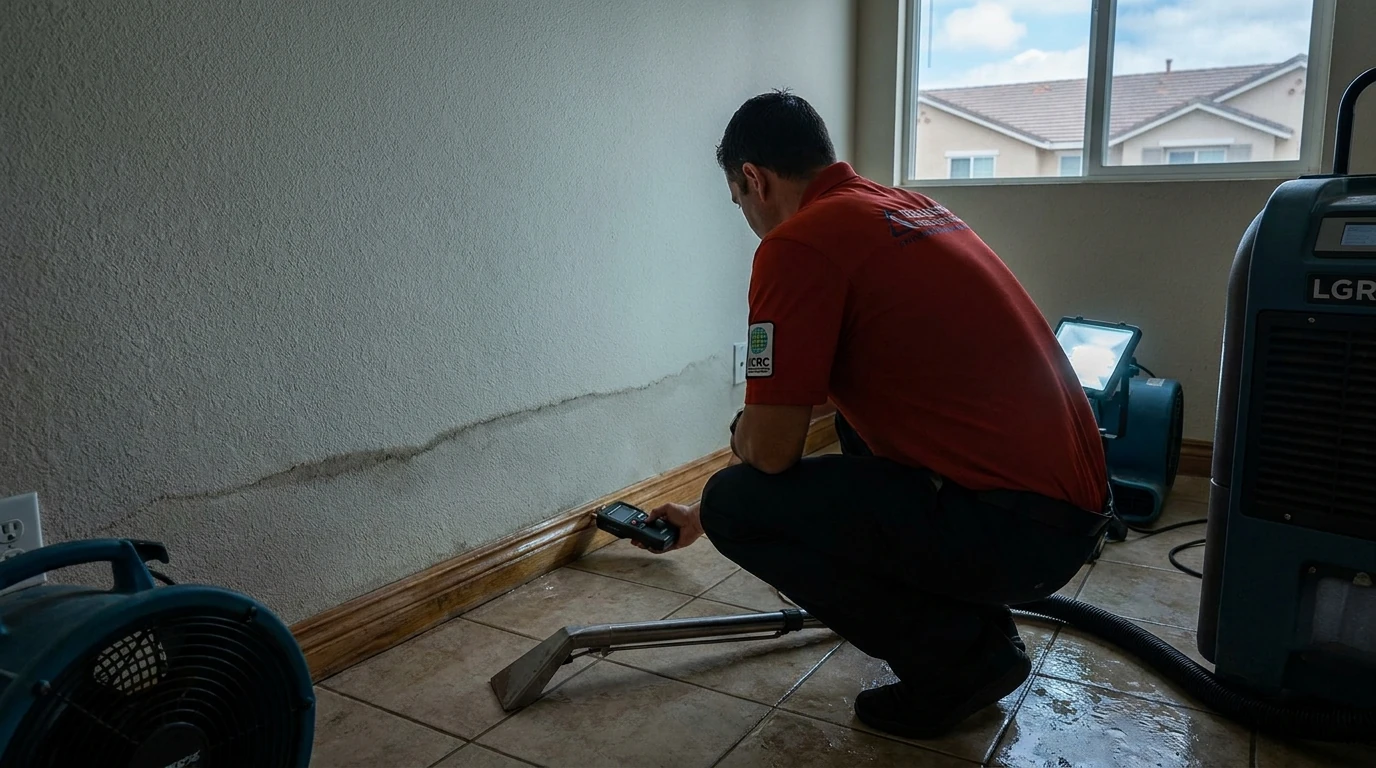
- Maps moisture in walls, flooring, and subfloor with a moisture meter, marking the boundary between wet and dry materials
- Extracts standing water with truck-mounted or portable extraction equipment
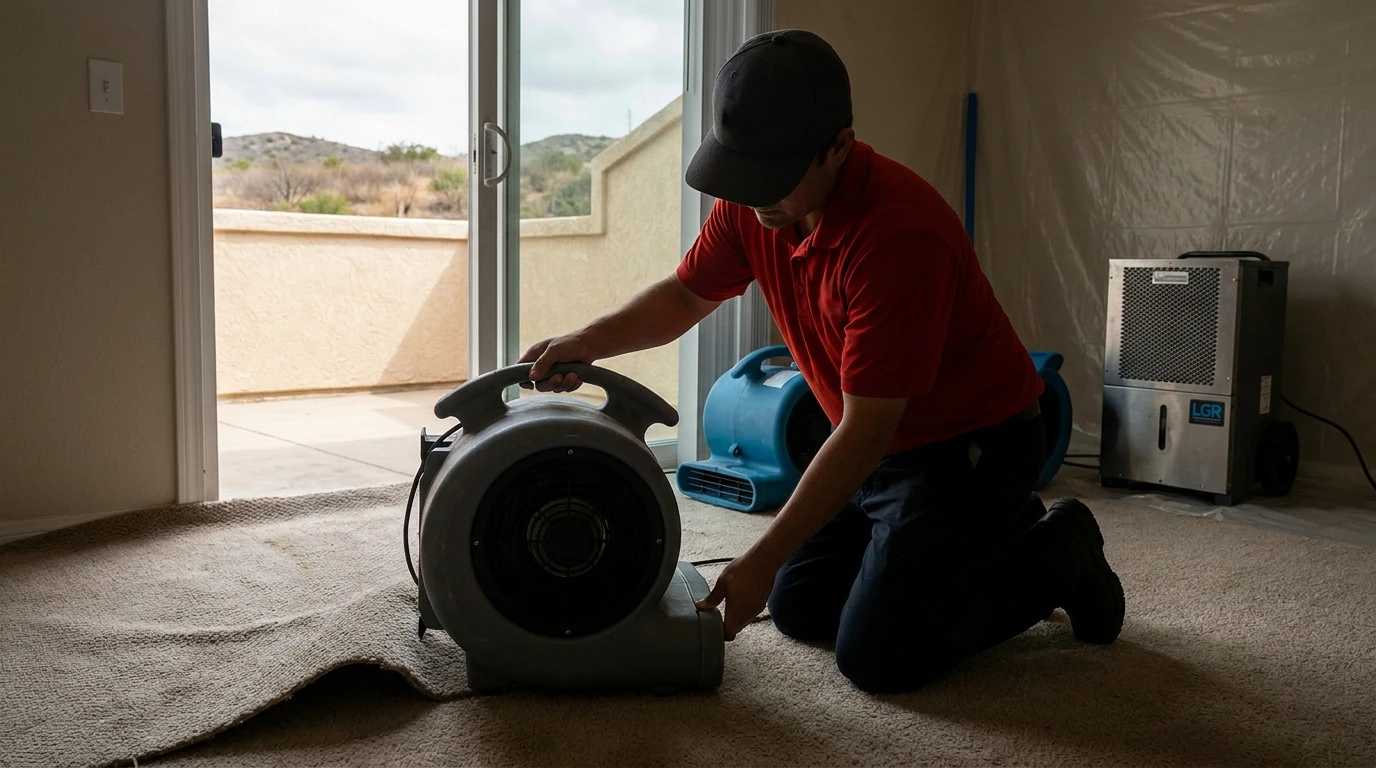
- Sets drying equipment: air movers positioned to create airflow across wet surfaces, and LGR dehumidifiers sized to the affected area
- Documents everything with photos and a moisture log, which becomes the paper trail for your insurance claim
That moisture log matters more than most homeowners expect. Insurance adjusters want to see daily readings showing materials returning to a dry standard before drying equipment is pulled, not just a verbal “it’s dry now.” If you’re still working through whether your policy covers the loss at all, our post on whether homeowners insurance covers water damage breaks down what’s typically covered versus excluded.
What should you ask before you hire anyone?
Ask for a written scope of work, a drying log, and confirmation of how they bill your insurance company, before any equipment goes in the house. These three answers tell you whether you’re dealing with a company that documents its work properly or one that’s going to leave you arguing with an adjuster later.
Specific questions worth asking on that first call:
- Will you document moisture readings daily and provide a drying log? This is what proves the job is actually finished, not just that equipment ran for a few days.
- Do you bill insurance directly, or do I pay and submit for reimbursement? Get this answer in writing before work starts, not after.
- Is the estimate itemized by category of loss and affected material? A vague lump-sum number is harder to reconcile against your policy.
- What’s included versus what becomes a separate reconstruction estimate? Extraction and drying (mitigation) and rebuilding drywall or flooring (reconstruction) are often two different scopes, sometimes two different invoices.
If the timeline is a concern, how long water damage restoration actually takes covers the typical drying window so you know what to expect before equipment arrives.
If you’re dealing with standing water right now in Shadowridge, Downtown Vista, Buena Creek, or anywhere near the Vista Business Park, getting the source stopped and the call made in the same hour keeps a one-room problem from becoming a whole-house one. Request a water damage assessment and a technician can walk you through next steps on the phone before anyone arrives.
About Dry 1 Out Restoration and Construction
Dry 1 Out Restoration and Construction is an IICRC Certified Firm based in Vista, CA, licensed (#993442) and insured, serving homeowners from Shadowridge to Downtown Vista and across San Diego’s North County. The team holds IICRC credentials in water restoration (WRT), structural drying (ASD), mold remediation (AMRT), and fire and smoke restoration (FSRT), and answers calls 24/7. This post was prepared with the Dry 1 Out team by Jason Pacheco.