24/7 Emergency Sewage Cleanup and Sanitization in Vista
24/7 emergency sewage cleanup and sanitization in Vista and surrounding areas. IICRC-certified, insurance billing accepted. Call (888) 379-1688.
Sewage backup in your home or business? Call now for emergency service. Raw sewage carries bacteria, viruses, and parasites that can contaminate a structure within hours of a backup, and the longer wastewater sits in carpet, drywall, or crawlspace soil, the more it has to be removed rather than cleaned. Dry 1 Out Restoration and Construction answers 24/7 for sewage cleanup and sanitization in Vista, whether the source is a sewer line backup, a failed septic system, or an overflowing fixture.
What Sewage Cleanup and Sanitization actually involves
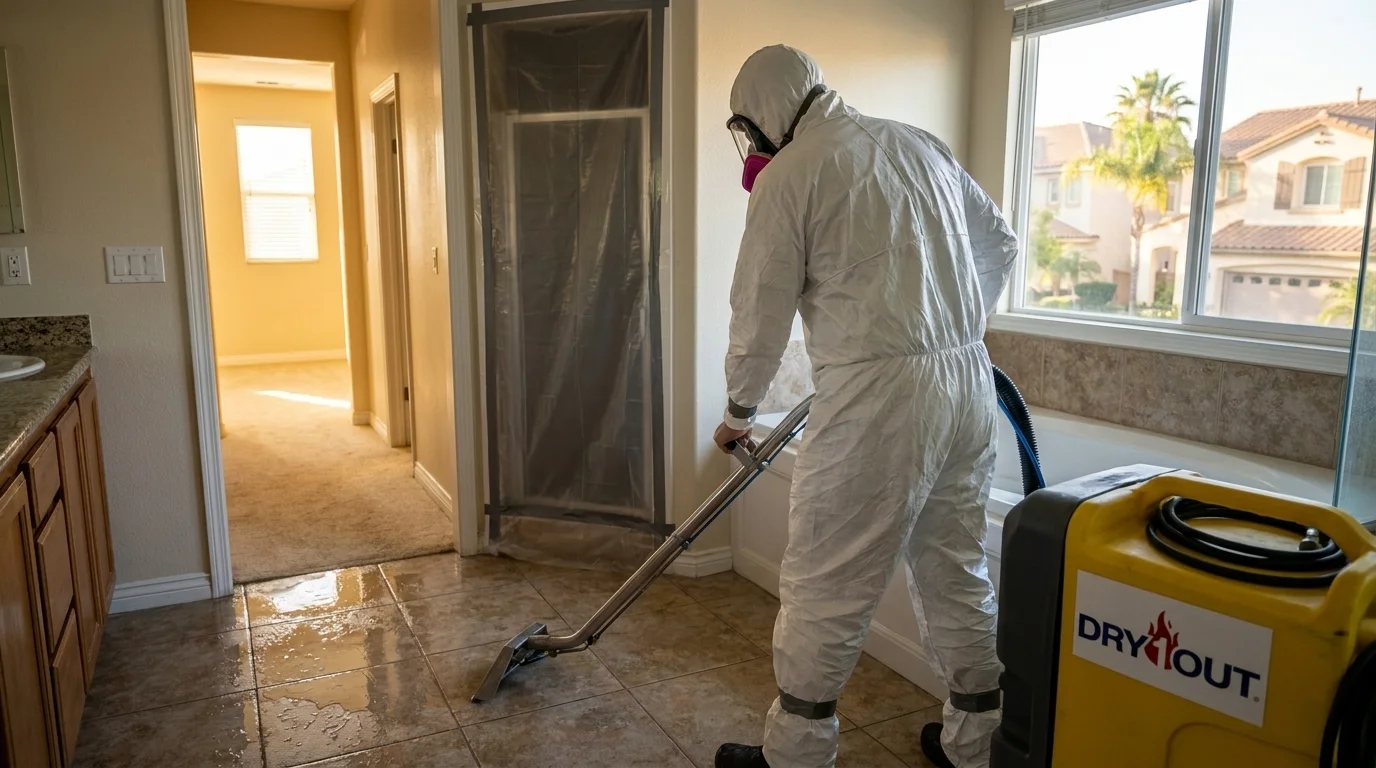
Sewage intrusion is classified as Category 3 water under the IICRC S500 standard, meaning it’s treated as grossly contaminated regardless of its original source. That classification changes the whole approach: porous materials that might be salvaged after a clean-water leak, carpet pad, drywall below the flood line, insulation, upholstery, usually have to come out. Crews work in full PPE (suits, respirators, nitrile gloves, rubber boots) and extract standing wastewater with trash pumps or truck-mounted vacuum units before any cleaning begins. Hard surfaces get cleaned, disinfected, and in many cases re-cleaned after a dwell time to let the antimicrobial agent work, then the space is dried and monitored like any other water loss. A contained single-room backup might wrap in a few days; a septic overflow that’s spread through a crawlspace or slab-on-grade foundation can take longer because of how much material has to be removed and how carefully the subfloor has to be verified dry before rebuild starts.
Our process
- PPE staging and safety perimeter. Before anyone enters the affected area, the crew suits up and isolates the space to keep contamination from tracking into unaffected rooms.
- Raw sewage extraction. Standing wastewater and solids are pumped and vacuumed out first, separate from any structural drying equipment that will be used later.
- Removal of contaminated porous materials. Carpet, pad, baseboards, and affected drywall are cut and removed per Category 3 protocol rather than cleaned in place.
- Cleaning and antimicrobial application. Remaining hard surfaces and framing are washed, disinfected with an EPA-registered antimicrobial, and given proper dwell time before the space is sealed back up.
- Drying, monitoring, and clearance. Moisture meters and thermal imaging confirm the subfloor and framing are back to a dry standard before any reconstruction begins.
What separates a good sewage cleanup response from a bad one
The most common shortcut is treating a sewage backup like a regular water loss, cleaning the surface and drying it out without removing porous materials that absorbed contaminated water. That gets a room looking fine while leaving bacteria and odor-causing residue inside wall cavities or under flooring, which usually resurfaces as a smell or a health complaint weeks later. A second mistake is skipping the dwell time on antimicrobial treatments, applying disinfectant and wiping it off before it’s had time to actually work. Adjusters reviewing a sewage claim typically want to see documentation that porous materials were removed (not just cleaned), photos of the contamination source, and moisture readings confirming the structure dried to an acceptable standard before rebuild. Missing that paper trail is one of the more common reasons a sewage-related claim gets questioned.
What does Sewage Cleanup and Sanitization cost?
Costs vary with how far the sewage spread, what materials were affected, and whether the backup involved a single bathroom or a larger area like a basement or crawlspace. These are typical industry ranges, not a quote; every loss is different, and Dry 1 Out Restoration and Construction provides a written scope of work before any cleanup begins. Homeowners insurance often covers sudden, accidental sewage backups (subject to the policy’s specific language and any sewer backup endorsement), though gradual seepage or lack of maintenance is frequently excluded.
| Scenario | Typical range |
|---|---|
| Single bathroom, contained backup | $1,500 - $3,500 |
| Basement sewage backup, moderate spread | $3,500 - $8,000 |
| Crawlspace or slab sewage intrusion | $5,000 - $12,000 |
| Septic overflow affecting multiple rooms | $8,000 - $18,000+ |
| Porous material removal and disposal (per room) | $800 - $2,000 |
Service area
Dry 1 Out Restoration and Construction handles sewage cleanup and sanitization throughout Vista and nearby North County communities, including Oceanside, San Marcos, Carlsbad, and Escondido. Older Vista neighborhoods with cast-iron or clay sewer laterals are more prone to root intrusion and line failures than homes with newer PVC plumbing, something crews account for when assessing whether a backup is likely to recur.
If sewage has backed up into your home or business, don’t wait for it to sit. Call (888) 379-1688 to begin sewage cleanup and sanitization before contamination spreads further into the structure.
Services We Handle
- Basement Sewage Cleanup
- Category 3 Water Cleanup
- Sewage Backup Cleanup
- Sewage Cleanup & Remediation
Frequently Asked Questions
Does homeowners insurance cover sewage cleanup and sanitization?
Why does drywall and carpet have to be removed instead of just cleaned after a sewage backup?
What's the difference between a sewer line backup and a septic overflow for cleanup purposes?
Is it safe to stay in the house while sewage cleanup is happening?
How do you know when a sewage-affected structure is actually clean and dry?
Looking for the best sewage cleanup and sanitization company in Vista?
Dry 1 Out Restoration and Construction provides licensed and insured sewage cleanup and sanitization in Vista, CA and the surrounding area, and has served local property owners since 2026. Customers rate us 5.0 out of 5 stars across 18 Google reviews. We answer calls 24/7 — call (888) 379-1688 for immediate help.
Need Sewage Cleanup and Sanitization now?
We respond 24/7 across Vista and surrounding CA cities.
Related Coverage
- Our Restoration Services
- Contact Dry 1 Out Restoration and Construction
- Restoration Services in Berkeley
- Restoration Services in Carlsbad
- Restoration Services in Chula Vista
- Restoration Services in Concord
- Restoration Services in El Cajon
- Restoration Services in Encinitas
- Restoration Services in Escondido
- Restoration Services in Fremont
- Restoration Services in Hayward
- Restoration Services in Oakland
- Restoration Services in Oceanside
- Restoration Services in San Diego