TL;DR: Water damage restoration in California typically costs $1,200 to $3,500 for a single clean-water room and $7,000 to $15,000 for multi-room jobs that need drywall and flooring replacement. Category 3 (sewage) losses and jobs that uncover mold often run higher. The biggest cost drivers are how fast the water is removed, how many materials got wet, and which category of water caused the damage. Most homeowners policies cover sudden, accidental water damage but not gradual leaks, so documentation matters as much as the drying equipment.
If a water heater just failed in your Hayward Highlands garage or a supply line let go under a sink in Mt. Eden, you’re probably staring at wet drywall and trying to guess what this is going to cost before the adjuster even calls back. The honest answer is: it depends on how much got wet and how fast someone with the right equipment shows up. Here’s what water damage restoration actually runs in California right now, and what moves that number up or down.
How Much Does Water Damage Restoration Cost in California?
Most residential water damage restoration jobs in California run between $1,200 and $15,000, with the majority falling in the $3,000 to $7,000 range for a contained, multi-room loss. The spread is wide because restoration pricing is driven by water category, square footage affected, and whether materials need to be replaced rather than dried in place.
In the Bay Area, including Hayward, Fairway Park, and the Tennyson-Alquire corridor, labor and disposal costs tend to run slightly above inland or rural California markets, which nudges jobs toward the higher end of these ranges. Coastal fog-belt homes and older East Bay housing stock with original plumbing also tend to need more drying time once a leak is caught.
Typical Water Damage Restoration Costs in California
| Scenario | Typical Cost Range |
|---|---|
| Single room, clean water (Category 1), minor extraction + drying | $1,200 - $3,500 |
| Multi-room extraction and structural drying, Category 2 (gray water) | $3,000 - $7,000 |
| Category 3 water (sewage or flood, black water) cleanup | $5,000 - $10,000+ |
| Water damage requiring drywall, baseboard, or flooring replacement | $7,000 - $15,000 |
| Basement or crawlspace flooding with structural drying | $4,000 - $9,000 |
| Water damage that has progressed to mold growth | add $1,500 - $6,000 for remediation |
These are typical industry ranges for California jobs, not a quote. Every loss is different, and Dry 1 Out Restoration and Construction provides a written scope of work before any work begins, so you know the number before equipment goes in the door.
What Factors Affect the Cost of Water Damage Restoration?
The single biggest factor is the category and class of water, followed closely by how much time passed before extraction started. A Category 1 leak caught within hours costs far less to dry than the same leak discovered three days later once it’s wicked into baseboards and subfloor.
Category matters because it determines what can be dried versus what has to be removed. Category 1 is clean water from a supply line or appliance. Category 2 (gray water) comes from dishwashers or washing machine overflow and carries some contamination. Category 3, often called black water, includes sewage backups and floodwater and requires more aggressive protocols under the ANSI/IICRC S500 water damage restoration standard.
Other factors that move the price:
- Square footage affected - drying equipment (air movers, LGR dehumidifiers) is priced per unit, so a 200 square foot bathroom costs far less than a 1,200 square foot flooded first floor.
- Materials involved - hardwood floors, engineered flooring, and drywall with blown-in insulation often can’t be saved and add demolition and reconstruction costs.
- Response time - every day water sits raises the odds of secondary damage like swelling cabinetry, delamination, or mold growth, which adds a second project to the invoice.
- Code upgrades - if permitted repair work triggers current building code (GFCI outlets, updated insulation), that’s added cost beyond the original loss.
- Access and location - a wet crawlspace or a condo on a shared wall near Chabot College takes more labor hours than an open single-story slab home.
Does Homeowners Insurance Cover Water Damage Restoration Costs?
Most California homeowners policies cover water damage restoration when the cause was sudden and accidental, like a burst pipe or a failed appliance hose, but they typically exclude gradual leaks and long-term seepage. The distinction between “sudden” and “gradual” is where most claim disputes happen.
According to the Insurance Information Institute, a standard homeowners policy generally covers water damage from plumbing failures, but damage from poor maintenance, slow leaks behind walls, or flooding from an outside water source (which requires separate flood insurance) is usually excluded. That means the adjuster is going to ask when you first noticed the problem and whether it could have been caught sooner.
Your deductible still applies, typically $1,000 to $2,500 on most California policies, so a $3,000 claim after a $1,500 deductible nets $1,500 from the insurer. This is where documentation protects the claim: photos of the source before cleanup starts, moisture readings, and a detailed scope of work. Our technicians document the loss from the first walkthrough so the paper trail supports your claim rather than leaving gaps an adjuster can use to deny it. We’ve also written more on what most homeowners’ policies actually cover if you want the longer breakdown.
What Happens During a Professional Water Damage Restoration Job?
A standard water damage restoration job follows five phases: assessment, extraction, drying, cleaning, and repair. Each phase is priced and documented separately, which is why a written scope matters more than a verbal estimate.
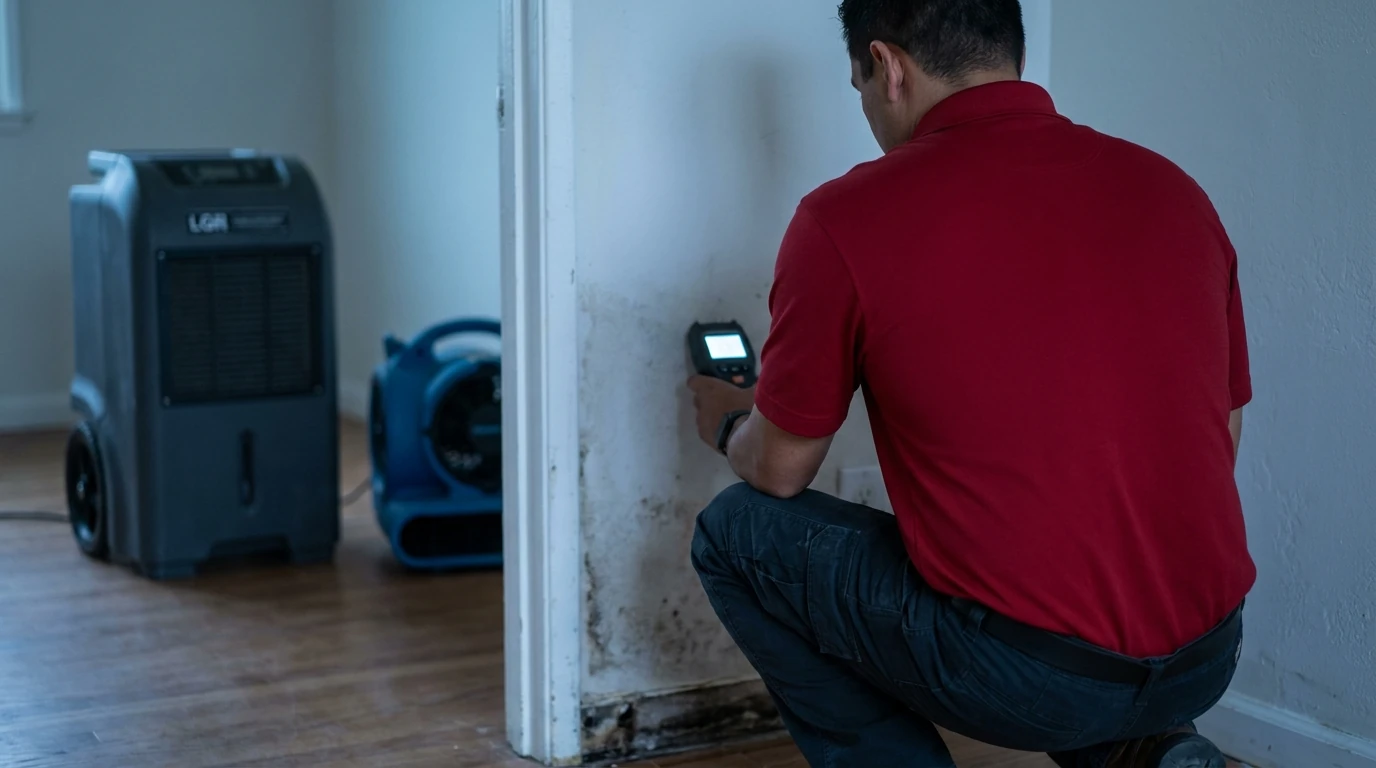
- Assessment and moisture mapping. A technician uses a moisture meter and, on larger losses, a thermal camera to map how far the water traveled behind walls and under flooring, not just where it’s visible.
- Water extraction. Truck-mounted or portable extraction units remove standing water. This phase is usually fast, often same-day.
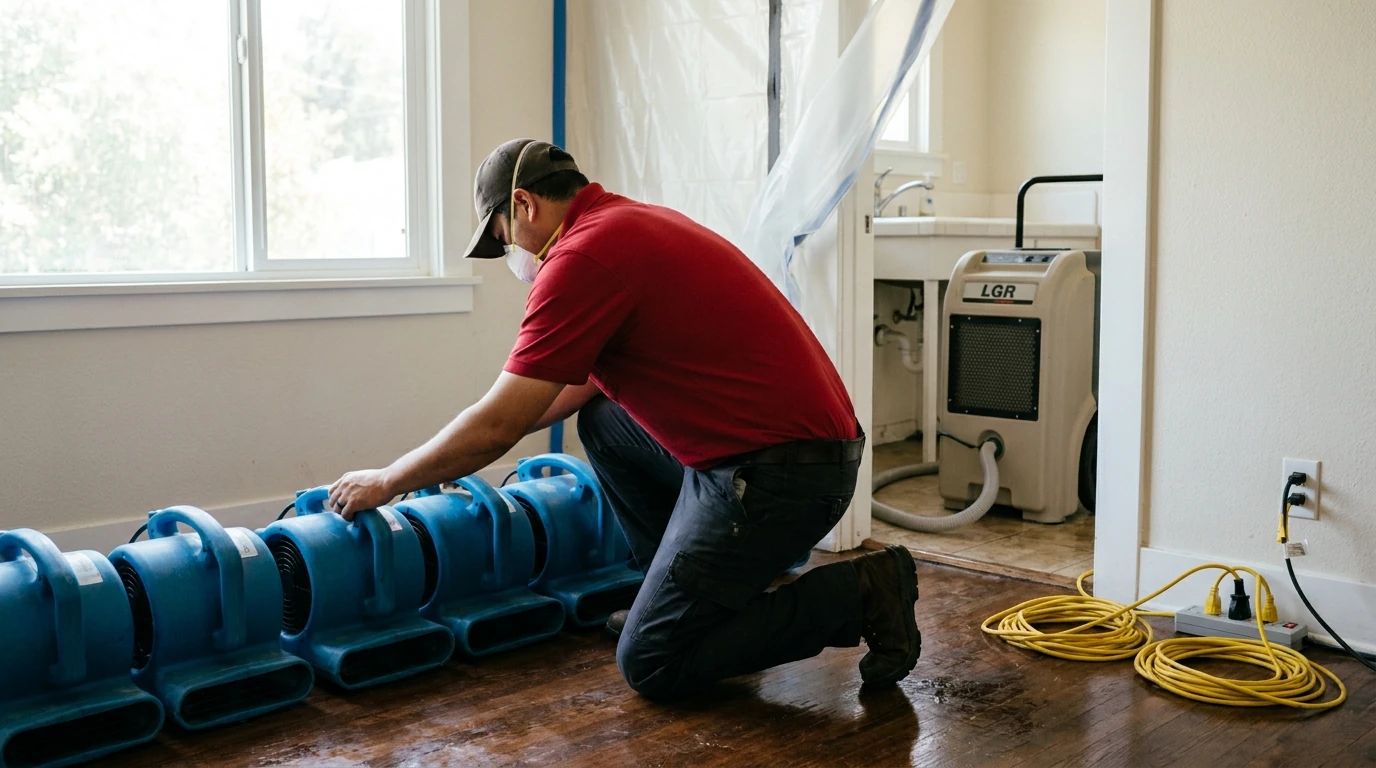
- Structural drying. Air movers and LGR dehumidifiers are placed based on the moisture map and monitored daily until materials hit a dry standard, typically 3 to 5 days for a contained loss, longer for dense materials like hardwood or plaster.
- Cleaning and sanitizing. Category 2 and 3 losses get antimicrobial treatment on affected surfaces before the space is cleared for repair.
- Repair and reconstruction. Drywall, baseboard, flooring, and paint are replaced as needed, often handled under the same company so there’s one point of contact from the first call to the final walkthrough.
How Can Hayward Homeowners Keep Water Damage Costs Down?
The fastest way to control the final cost is to stop the water source and start extraction within the first few hours, not days. Older Hayward housing stock, including homes near Downtown Hayward and the Hayward Highlands with original galvanized plumbing, is more prone to pinhole leaks that go unnoticed until a wall or ceiling stain shows up.
If you catch a leak early, shut off the water at the fixture or the main, and call for extraction the same day, you’re far more likely to land in the $1,200 to $3,500 range than the $7,000-plus range that comes with saturated subfloor and drywall. For homes near the Hayward Regional Shoreline or other flood-prone low-lying areas, a quick response also lowers the odds the job escalates into a mold remediation project layered on top of the water damage bill.
If you’re dealing with active water damage right now, the next step is getting a technician on-site to document the source and start drying before costs climb further. Call Dry 1 Out Restoration and Construction at (888) 379-1688 to schedule an assessment, or request a written scope through our water damage restoration page so you know the number before work starts.
About Dry 1 Out Restoration and Construction
Dry 1 Out Restoration and Construction is an IICRC Certified Firm (WRT, ASD, AMRT, FSRT) operating under California contractor license #993442, with offices in Vista and Hayward serving water damage, mold, fire, and reconstruction needs across the San Diego area and the Bay Area. This post was prepared with input from the Dry 1 Out team, led by Jason Pacheco.