Large Loss and Catastrophic Response in Vista
24/7 large loss and catastrophic response in Vista and surrounding areas. IICRC-certified, insurance billing accepted. Call (888) 379-1688.
Catastrophic loss response for Vista properties with no time to waste? When a water main break floods a 40-unit apartment complex, a commercial roof fails during a storm, or a fire tears through an occupied multi-tenant building, the math changes entirely. This isn’t a single flooded bathroom or a kitchen fire. It’s dozens of affected units, a claim value that can run into seven figures, multiple insurance carriers or a single large-loss adjuster managing the whole file, and a property owner who needs square footage back in production fast. We answer 24/7 and mobilize crews and equipment sized to the scope of the loss, not a standard residential call.
What a large loss response actually involves
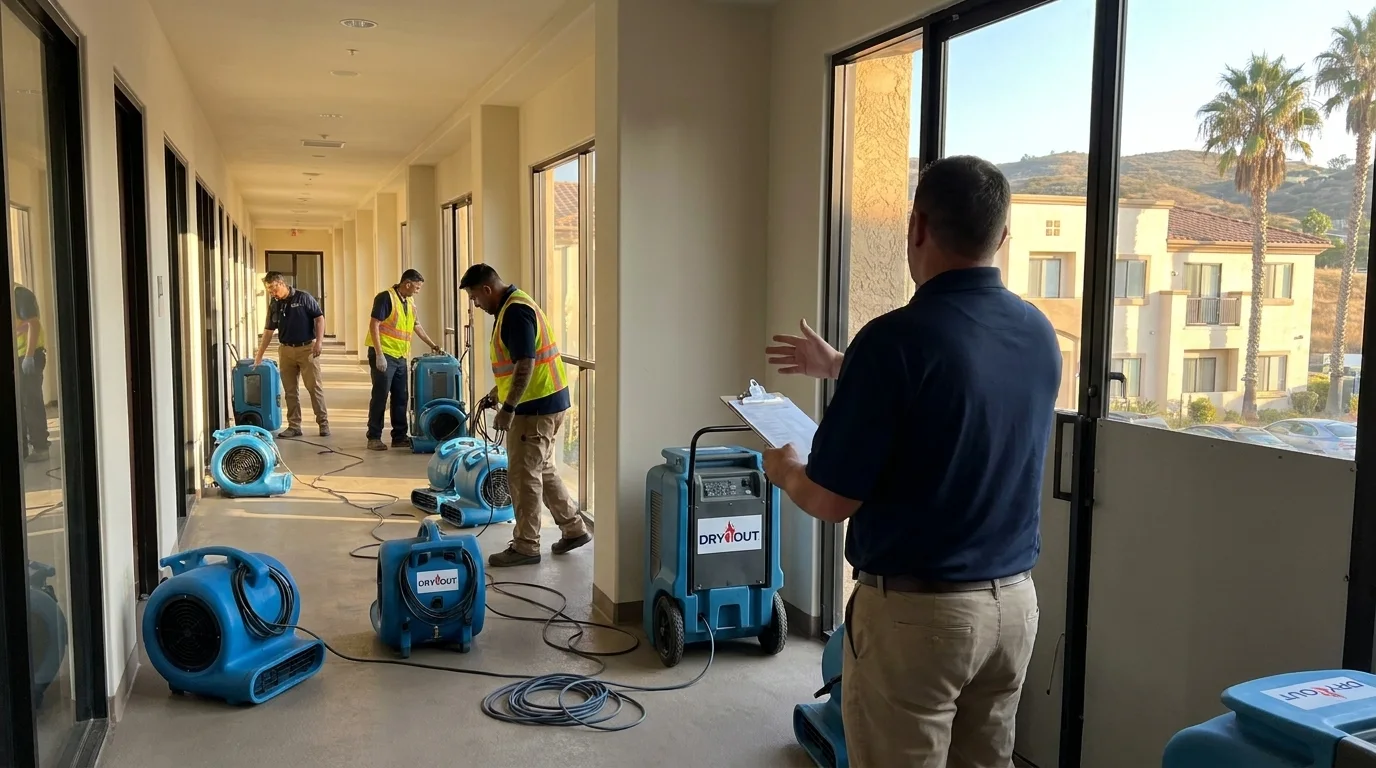
Large loss and catastrophic restoration is defined less by the type of damage and more by its scale and complexity. A loss typically crosses into “large loss” territory when it spans multiple units or structures, involves a commercial or multi-family property, or carries an estimated claim value that insurers route to a dedicated large-loss or catastrophe adjuster rather than a standard field adjuster. That changes how the job runs. Instead of a two- or three-person crew with a handful of air movers, a catastrophic response calls for coordinated teams working multiple structures simultaneously, industrial-capacity extraction and desiccant dehumidification equipment, and documentation built around Xactimate line-item estimating from day one because the carrier’s review process is more rigorous at this claim size.
Timeline matters more here, not less. A delayed response on a single-unit water loss means one family out of their home longer. A delayed response on a 60-unit complex means 60 units accumulating secondary damage, tenants relocated, and a property owner losing rental income on every day the structure sits wet or unsecured.
Our process
- Scene assessment and multi-structure scoping. Before equipment moves, we map the full extent of the loss across every affected unit or structure, not just the units with the most visible damage, because moisture and smoke migration rarely respect unit lines.
- Resource mobilization. Crew size, drying equipment count, and any subcontracted trades (electrical, structural, demo) are scaled to the footprint of the loss, not deployed incrementally as problems surface.
- Carrier and adjuster coordination. On large losses, we work directly with the assigned large-loss adjuster or catastrophe team, aligning our Xactimate scope with their review process and providing daily or weekly progress documentation rather than a single final report.
- Phased mitigation and drying. Affected units or zones are prioritized by severity and by what’s needed to get occupants or tenants back in place fastest, with moisture monitoring tracked per zone so drying decisions are made on data, not guesswork.
- Reconciliation and closeout. Photo documentation, moisture logs, and equipment run-time records are compiled into a file built to withstand carrier audit, since large claims get scrutinized more closely than standard ones.
What separates a good large loss response from a bad one
The most common failure on catastrophic jobs isn’t technical, it’s logistical: a contractor underestimates how much equipment and labor the scope actually requires and tries to run a multi-structure loss like three separate single-unit jobs. That shows up as inconsistent drying times across units, missed secondary moisture in shared walls or chases, and a documentation trail too thin to support the claim value.
Adjusters reviewing large-loss files look for a few specific things: moisture readings logged per room or unit (not just a single summary number), equipment placement that matches the documented wet area, and a clear chain of custody on anything removed for drying or disposal. Jobs that get flagged for supplemental review usually have gaps in exactly these areas. A property owner and their adjuster are both better served by a scope document that holds up to scrutiny the first time than by a faster-looking estimate that gets kicked back for revisions.
What does large loss and catastrophic response cost?
Cost on large-loss work scales with structure count, square footage, and the category of water or degree of fire and smoke involved, so industry-typical ranges are wide. Every loss gets a written scope before work begins, built from direct measurement and photo documentation rather than a flat estimate. In most cases, the property’s commercial or multi-family policy covers mitigation and reconstruction for a covered peril, though coverage specifics (business interruption, code-upgrade coverage, ordinance and law) vary by policy and are worth reviewing with the adjuster early.
| Scenario | Typical range |
|---|---|
| Multi-unit apartment water loss (10-20 units) | $75,000 - $250,000 |
| Commercial building fire, single structure | $150,000 - $750,000 |
| Large retail or warehouse flood event | $100,000 - $500,000 |
| Multi-building storm damage (roof, water intrusion) | $200,000 - $1,000,000+ |
| Mixed-use property, fire with smoke throughout | $300,000 - $900,000 |
Seasonal & regional considerations
Vista’s dry season brings Santa Ana wind events that elevate wildfire risk for commercial and multi-family properties near wildland-urban interface zones, while the winter months bring atmospheric river storms capable of overwhelming aging roof systems and site drainage on larger commercial footprints. Properties built before modern stormwater codes are more prone to large-scale water intrusion during these events, which is often how a single storm turns into a multi-structure, large-loss claim rather than an isolated repair.
Service area
We respond to large loss and catastrophic events throughout Vista and across North San Diego County, including Oceanside, San Marcos, Escondido, Carlsbad, and Fallbrook, for commercial, multi-family, and mixed-use properties.
If you’re managing a multi-unit or commercial loss and need a crew that can scale to the actual size of the damage, call Dry 1 Out Restoration and Construction at (888) 379-1688 to start large-loss mobilization and get a written scope in front of your adjuster fast.
Frequently Asked Questions
Does insurance cover large loss and catastrophic restoration?
What makes a loss qualify as 'large loss' instead of a standard claim?
How do you coordinate with a large-loss or catastrophe adjuster?
How quickly can a crew be mobilized for a multi-unit or commercial loss?
What documentation gets tracked on a large loss or catastrophic file?
Looking for the best large loss and catastrophic response company in Vista?
Dry 1 Out Restoration and Construction provides licensed and insured large loss and catastrophic response in Vista, CA and the surrounding area, and has served local property owners since 2026. Customers rate us 5.0 out of 5 stars across 18 Google reviews. We answer calls 24/7 — call (888) 379-1688 for immediate help.
Need Large Loss and Catastrophic Response now?
We respond 24/7 across Vista and surrounding CA cities.
Related Coverage
- Our Restoration Services
- Contact Dry 1 Out Restoration and Construction
- Restoration Services in Berkeley
- Restoration Services in Carlsbad
- Restoration Services in Chula Vista
- Restoration Services in Concord
- Restoration Services in El Cajon
- Restoration Services in Encinitas
- Restoration Services in Escondido
- Restoration Services in Fremont
- Restoration Services in Hayward
- Restoration Services in Oakland
- Restoration Services in Oceanside
- Restoration Services in San Diego