Mold Remediation in San Marcos
24/7 mold remediation in San Marcos, CA. IICRC-certified, insurance billing accepted. Call (888) 379-1688.
Our IICRC-certified technicians are dispatched from our Vista, CA headquarters and are typically on-site in San Marcos within 60 minutes of your call.
Mold remediation in San Marcos comes with a wrinkle most of the county doesn’t deal with: the mix of hillside stucco homes near Double Peak Park, older slab houses in Richland, and well-fed rural lots out toward Twin Oaks Valley all trap moisture in different ways. A mold problem that starts behind a San Elijo Hills shower surround doesn’t behave like one growing under a Richland crawlspace, and treating them the same way is how jobs get re-opened.
Why San Marcos Properties See Mold Issues
San Marcos sits in a basin ringed by hills, and that geography matters more than people expect. Neighborhoods closer to Lake San Marcos and the lower flats hold onto morning marine layer moisture longer than properties up near Double Peak Park, which means crawlspaces and north-facing exterior walls in those lower zones stay damp well into the afternoon. Add in the stucco cladding common across San Elijo Hills and Santa Fe Hills, much of it built in the 2000s with synthetic (EIFS) systems, and you get walls that can trap bulk water behind the finish coat for weeks before a stain ever shows up indoors. In Richland’s older stock and the larger lots out in Twin Oaks Valley, the more common driver is plumbing age, swamp cooler lines, or irrigation runoff pooling against foundations that were never graded for today’s denser landscaping. Mold colonizes most of these conditions within 24 to 48 hours of sustained moisture, which is why a slow stucco leak or an undetected slab leak near Palomar College or Cal State San Marcos can turn into a remediation job before anyone notices a smell.
Our Mold Remediation Process in San Marcos
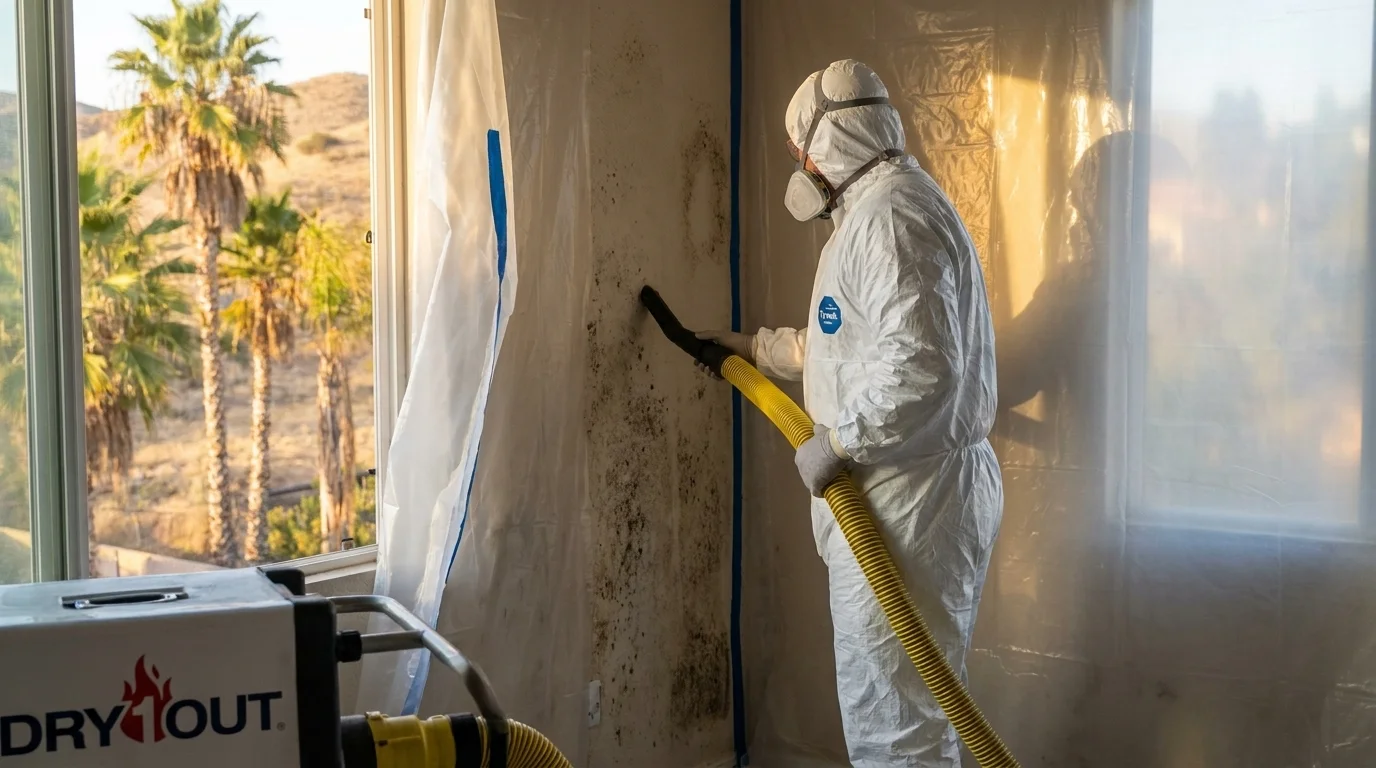
We start with a moisture map, not a guess. Our techs use moisture meters and, where EIFS stucco is involved, invasive probe testing to find trapped water behind the cladding rather than assuming surface staining tells the whole story. Once we’ve confirmed the extent of growth, we isolate the work area with physical containment and negative air machines so spores don’t migrate into HVAC returns or adjoining rooms, which matters a lot in the tighter floor plans common to newer San Elijo Hills and Santa Fe Hills construction. Affected porous materials, drywall, insulation, baseboard, get removed and bagged for disposal; non-porous surfaces are HEPA-vacuumed and treated per IICRC S520 guidelines. We close the loop with air scrubbers running through the drying phase and, where a homeowner or HOA wants documentation, we coordinate third-party clearance testing before we pack out.
San Marcos HOA Coordination
A good share of San Marcos mold calls come from HOA-governed communities, and San Elijo Hills and Santa Fe Hills both have association covenants that can require notice before work starts on shared walls, common-area plumbing chases, or exterior stucco penetrations. We’ve built our documentation process to hand associations what they typically ask for: photos, moisture logs, and scope of work, so approval doesn’t stall the job. For insurance-covered losses, whether the trigger was a slab leak, a roof intrusion, or a failed irrigation line, we photograph and log the damage as we find it so the claim has what an adjuster needs without the homeowner chasing paperwork mid-remediation.
Local note
One thing we watch closely in San Marcos: homes in the lower basin near Lake San Marcos hold higher ambient humidity through the morning hours than hillside properties up toward Double Peak Park, even on the same calendar day. That gap changes how long a crawlspace or slab stays wet after a leak, and it’s part of why we pull humidity readings at the start of a job instead of relying on general county averages.
If you’re seeing a musty smell, a soft spot in drywall, or discoloration anywhere from a San Elijo Hills townhome to a Twin Oaks Valley barn, Dry 1 Out Restoration and Construction is licensed (#993442) and answers 24/7 for mold remediation across San Marcos, including the 92069 and 92078 ZIPs. Call (888) 379-1688 to get a technician assessing the moisture source before it spreads further.
Serving San Marcos from our Vista headquarters — ★ 5.0 · 18 Google reviews
“Alberto and dry out did a great job responding quickly and professionally will be using them again!” — Joseph, September 2026Read our reviews on Google →
Mold Remediation in San Marcos: Service Coverage
Frequently Asked Questions
How fast can you arrive for mold remediation in San Marcos?
Does San Elijo Hills' stucco construction change how mold remediation works there?
Do HOAs in San Marcos require anything specific before mold work starts?
Are Richland and Twin Oaks Valley homes more prone to certain mold triggers?
How do you handle mold near Lake San Marcos where humidity sits higher longer?
What does mold remediation typically involve for a slab-foundation home near Cal State San Marcos or Palomar College?
Will my homeowners insurance cover mold remediation in San Marcos?
Mold Remediation response in San Marcos
Most San Marcos calls see a technician on-site within 60 minutes from our Vista headquarters.