Fire damage restoration follows a sequence: securing the structure, assessing smoke and water damage, removing soot and odor from every porous surface, then repairing or rebuilding what the fire destroyed. The process typically runs from a same-day board-up and inspection through weeks of cleaning, deodorizing, and reconstruction, depending on how much of the structure burned and how far smoke traveled into HVAC systems, insulation, and framing. Insurance documentation runs alongside every step. Understanding the order of operations helps you know what’s normal, what questions to ask your adjuster, and when a stage is being rushed or skipped.
What Actually Happens After a Fire
Fire damage is rarely just the burned room. Heat warps framing and melts wiring insulation even where flames didn’t reach. Smoke carries acidic soot particles through ductwork, settling on walls, cabinetry, and fabric two or three rooms away from the fire’s origin. Water from firefighting efforts soaks drywall, subfloor, and insulation, and that moisture starts supporting mold growth within 24 to 48 hours if it isn’t addressed. A home can look structurally fine from the street and still have a layer of soot film coating every surface inside, plus trapped moisture behind the walls that firefighters’ hoses left behind.
The type of fire matters too. A grease fire in the kitchen leaves a different residue than a electrical fire in the walls or a wildfire-driven ember fire that enters through vents and eaves, which is a real risk in the inland canyons and brush-adjacent neighborhoods around Vista. Protein-based smoke from a kitchen fire tends to leave a thin, sticky, hard-to-see film with a strong odor. Synthetic fires involving furniture, plastics, or electronics leave a heavier, oily soot that smears if you try to wipe it with a dry cloth.
Immediate Steps After the Fire Is Out
- Confirm the fire department has cleared the structure. Don’t re-enter until they say it’s safe, even if the damage looks contained to one room.
- Call your insurance carrier before you touch anything. Most policies require prompt notice, and an adjuster will want to see the damage close to its original state.
- Photograph everything before moving items, boarding windows, or starting any cleanup. Wide shots of each room, then close-ups of damaged items and structural elements.
- Secure the structure with temporary board-up on broken windows or burned-through walls, and tarp any roof openings to keep weather and animals out.
- Shut off utilities if they weren’t already cut by the fire department, particularly gas lines if you smell anything unusual.
- List what you remember losing while it’s fresh, room by room, for the claim.
If the home is still habitable in parts, open windows briefly for ventilation (weather permitting) but don’t run the HVAC system until it’s been inspected. Soot in the ductwork will recirculate through every vent in the house the moment the blower turns on.
What Not to Do Before Help Arrives
- Don’t wipe soot off walls or fabric with a damp cloth. Water activates the acidic compounds in soot and can set a permanent stain or etch glass and metal finishes.
- Don’t use household cleaners on soot-covered surfaces. Most consumer cleaners spread the residue rather than lifting it, and some react with soot chemistry in ways that make odor worse.
- Don’t run ceiling fans or the HVAC system. Both will move settled soot particles back into the air and onto surfaces you’ve already cleaned.
- Don’t throw away damaged items before they’re photographed and listed. Even items headed for the trash should be documented for the claim first.
- Don’t assume food, medicine, or cosmetics exposed to heat or smoke are still safe to use. Heat and combustion byproducts can contaminate sealed containers in ways that aren’t visible.
When to Call a Restoration Professional
Small, contained incidents, like a scorched pot on the stove with minimal smoke spread, may be a cleanup job for a homeowner with gloves, odor-neutralizing products, and patience. Most structure fires are not that simple. Call a professional when:
- Smoke odor is noticeable in rooms away from the fire’s origin, which usually means it’s in the HVAC system, insulation, or wall cavities.
- Firefighting water has soaked carpet, drywall, or subfloor, since untreated moisture leads to mold within one to two days.
- The fire reached structural framing, electrical, or plumbing, which needs inspection before any rebuild.
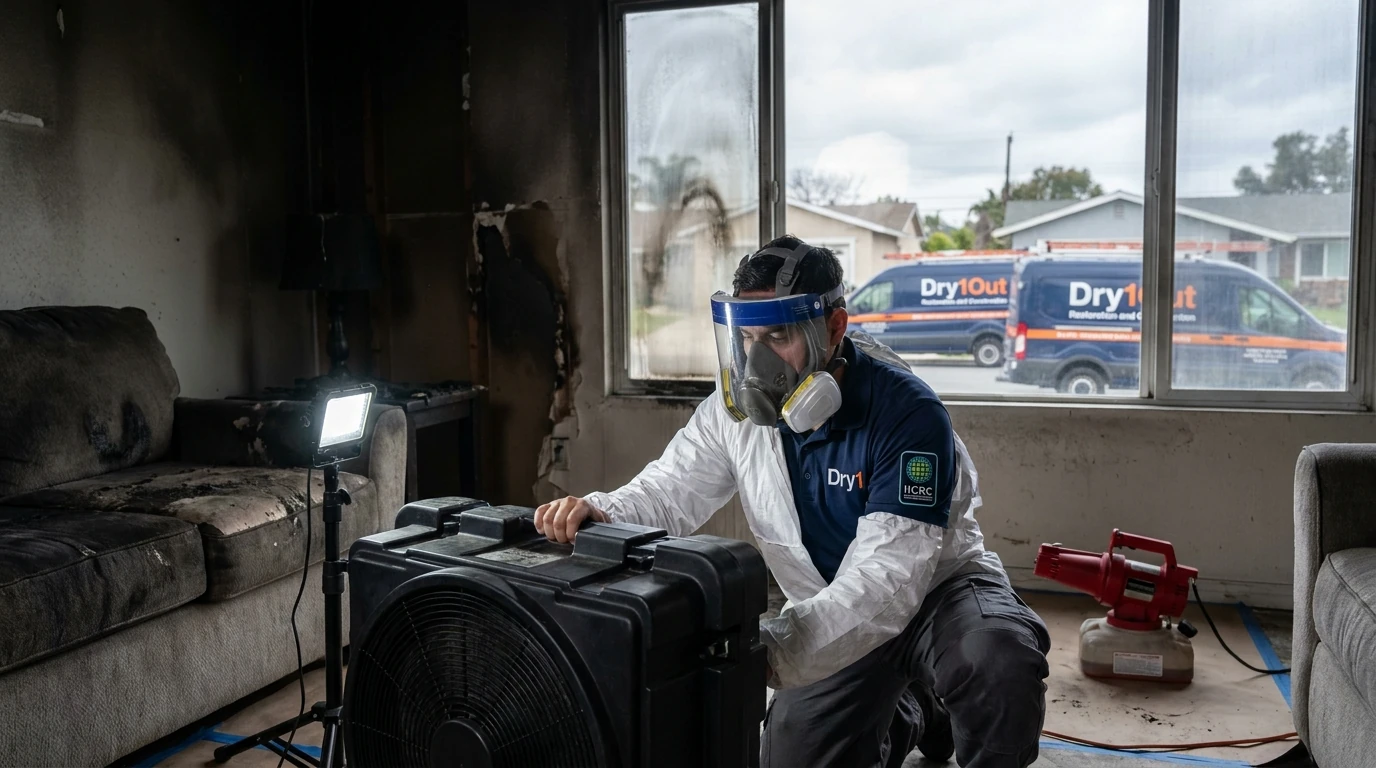
- Soot has coated hard surfaces, upholstery, or HVAC components, since specialized cleaning agents and equipment (thermal foggers, ozone or hydroxyl generators, HEPA vacuums) outperform retail products for lifting embedded residue and neutralizing odor at the source.
Dry 1 Out Restoration and Construction handles fire damage restoration and smoke damage restoration for homes throughout Vista, including the drying and odor-removal work that follows firefighting water and the structural cleanup that comes before any rebuild. A call early in the process, even just for an assessment, gives you a clearer picture of scope before the insurance claim moves forward.
The Longer Recovery Process
Once the immediate hazards are handled, restoration generally moves through these phases:
- Assessment and documentation. A full walkthrough identifies what’s salvageable, what needs deep cleaning, and what has to be demolished and rebuilt, with everything photographed for the insurance file.
- Water extraction and structural drying. Firefighting water gets extracted and affected materials are dried, often with the same equipment and monitoring approach (per the IICRC S500 drying standard) used in water damage restoration, since fire damage almost always comes with a water damage component.
- Soot and residue removal. Surfaces are cleaned with techniques matched to the soot type, dry chemical sponges for some residues, wet cleaning for others, and HVAC systems are cleaned or the ductwork replaced if contamination is heavy.
- Odor neutralization. Thermal fogging, ozone treatment, or hydroxyl generators address odor that’s penetrated porous materials like drywall, insulation, and framing, not just the surface smell.
- Reconstruction. Anything demolished, burned-through drywall, damaged framing, ruined flooring, gets rebuilt to match the home’s prior condition, coordinated with your insurance adjuster on scope and cost.
Timelines vary widely. A single-room kitchen fire with contained smoke might wrap up in a week or two. A fire that spread through an attic or multiple rooms, especially with significant water damage, can take several weeks to a few months between drying, cleaning, and rebuild.
Fire damage is one of the few disasters where the visible damage and the actual damage rarely match. A single room may look like the whole story, while smoke and moisture have already moved into places you can’t see. If you’re standing in a home after a fire and trying to figure out what’s next, a professional assessment early on, before cleanup decisions are made that can’t be undone, is usually the most useful first call. Dry 1 Out Restoration and Construction can walk the property with you and lay out what’s involved before you commit to next steps. Reach the team at (888) 379-1688.