
The Short Answer
There is no reliable way to identify “black mold” versus any other mold by color alone, and that includes the species most people mean when they say it: Stachybotrys chartarum. Plenty of harmless, common molds are black, gray-black, or dark green, and some strains of Stachybotrys look more olive or brown depending on how wet the surface is. Color, texture, and smell can give you clues that mold is present and that you have a moisture problem, but the only way to know which species you’re dealing with is lab testing. For most homeowners, the species matters less than the questions that come next: how did this get wet, how long has it been wet, and how far has it spread.
What People Usually See
Mold shows up in a handful of recognizable patterns, and the pattern usually tells you more than the color does.
- Fuzzy or powdery patches on drywall, grout, or wood, often starting in a corner or along a baseboard where humidity collects.
- Dark rings or halos around a stain from a slow leak, where the mold is feeding along the wet edge rather than the dry center.
- Slimy black film in a shower pan, window track, or under a sink, usually a fast-growing surface mold rather than a structural problem.
- A musty, earthy smell with no visible growth, which often means mold is active behind a wall, under flooring, or inside an HVAC return before it’s reached a surface you can see.
If you’re staring at a dark patch and trying to decide whether it’s “the dangerous kind,” the honest answer is you can’t tell by looking. What you can tell by looking is whether there’s an active moisture source nearby, which is the actual problem to solve.
Why Visual ID Isn’t the Point
Several dark-colored molds (Cladosporium, Alternaria, and some Aspergillus and Penicillium strains) are far more common in homes than Stachybotrys and can look nearly identical to the untrained eye. All of them grow under the same conditions: a surface that’s stayed damp for roughly 24 to 48 hours, organic material to feed on (drywall paper, wood, dust, grout haze), and still air. None of them should be left to spread regardless of species, because all mold growth is a sign that moisture is sitting somewhere it shouldn’t be, and that moisture source will keep causing damage (and keep feeding mold) until it’s found and fixed.
This is why a lab swab or air sample is worth more than a guess based on photos. If you want a species identification for your own peace of mind, or because a landlord, buyer, or insurance adjuster is asking, an independent mold test is the way to get an answer that holds up. Testing identifies what’s there; remediation deals with getting rid of it and the moisture behind it.
What Not To Do
- Don’t scrub it with bleach and call it solved. Bleach can lighten the surface stain on nonporous materials like tile, but it doesn’t reliably kill mold growing into porous material like drywall, wood, or grout, and it does nothing about the moisture source. The mold often comes back within days or weeks.
- Don’t dry-sand, dry-brush, or run a fan directly on a moldy surface. Disturbing dry mold releases spores into the air, which can spread the problem to rooms that were previously clean, especially if your HVAC system is running and circulating air through the house.
- Don’t seal it over with paint or caulk. Painting over an active colony traps moisture and often leads to bubbling, peeling, and a bigger patch showing up nearby within a few weeks.
- Don’t assume a small patch means a small problem. Visible mold on a surface is frequently just the part you can see; the same leak or condensation issue may already be affecting the wall cavity, subfloor, or insulation behind it.
When To Call a Professional
A small, isolated spot on a non-porous surface (shower tile, a windowsill) that you can clean immediately after it appears is usually a routine cleaning job, not a remediation job. Call in help when any of the following apply:
- The affected area is larger than roughly 10 square feet (about a 3-foot by 3-foot patch), which is the general threshold the EPA uses to distinguish a DIY cleanup from a job that needs professional containment.
- The growth followed a known water event, such as a roof leak, burst pipe, slow plumbing leak, or flooding, where moisture likely reached framing, subfloor, or insulation you can’t see or dry yourself.
- You or someone in the household has ongoing symptoms (coughing, congestion, headaches, skin or eye irritation) that improve when you’re out of the house. This isn’t something we can diagnose for you; it’s a reason to talk to a physician and have the environment assessed.
- You’ve cleaned it once already and it came back. Recurrence almost always means the moisture source was never fully addressed.
- You need documentation for an insurance claim, a real estate transaction, or a rental dispute, where photos and a self-cleaned surface won’t hold up the way a dated inspection and remediation record will.
What the Remediation Process Actually Looks Like
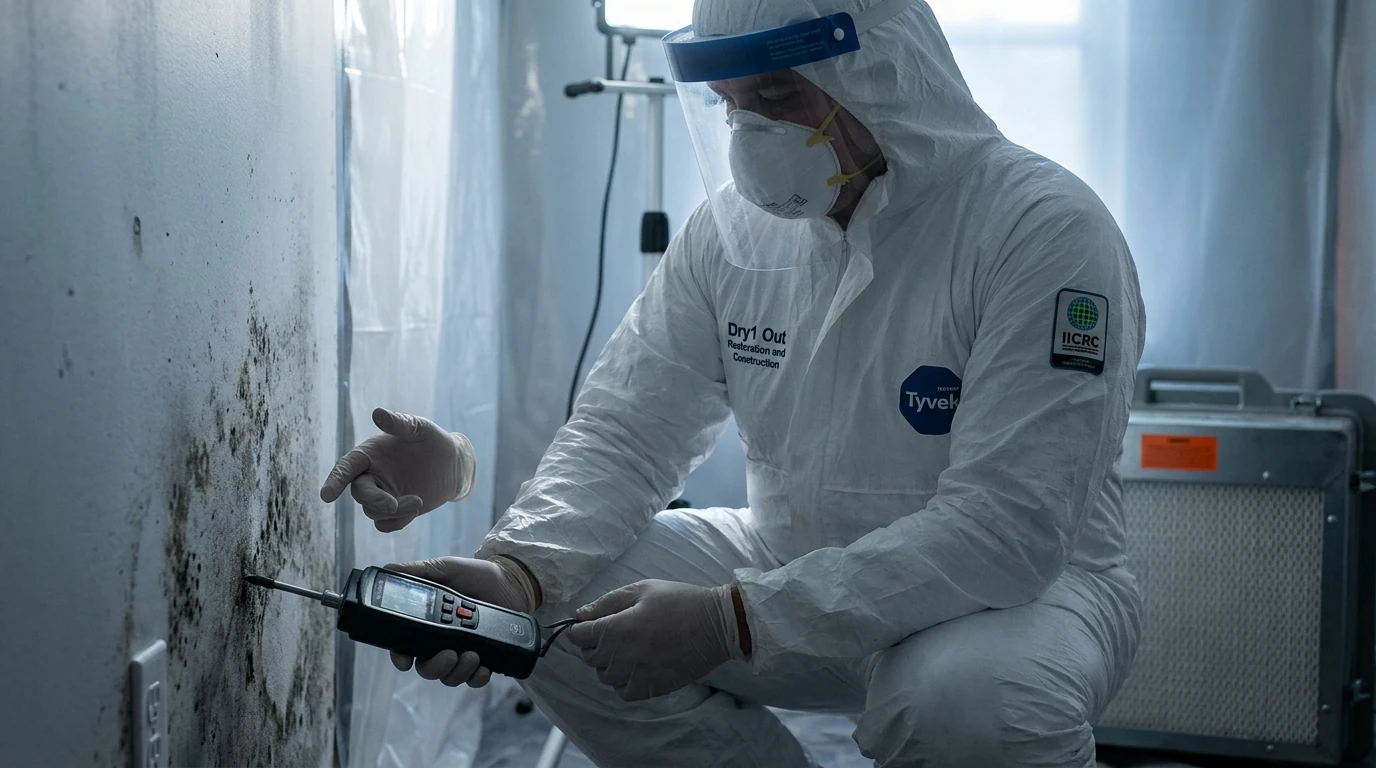
Professional mold remediation starts with finding and stopping the moisture source, because treating the mold without fixing the water problem is treating a symptom. From there, a typical job involves containing the affected area with plastic sheeting and negative air pressure to keep spores from spreading to clean parts of the house, removing material that’s too porous to clean (soft drywall, saturated insulation, warped subfloor), HEPA vacuuming and treating the remaining structure, and running air scrubbers and dehumidifiers until moisture readings in the materials come back down to a normal range. Work is generally dried and documented against the IICRC S520 mold remediation standard, which gives you a consistent benchmark regardless of who’s doing the work. Depending on what the moisture source turns out to be, this can overlap with water damage repairs, since the two problems are often the same job split into two phases.
If you’re in the Vista area and you’re past the point of a quick wipe-down, Dry 1 Out Restoration and Construction’s mold remediation team can assess the extent of the growth, identify the moisture source, and walk you through what containment and removal would actually involve before you commit to anything. Call (888) 379-1688 to talk through what you’re seeing and figure out the right next step.